The Unseen Thread: Introduction
Imagining the Women My Family Lineage Left Out
I come from a family that has recorded the firstborn son of each generation for over 2,500 years.
Our lineage traces back through dynasties and centuries, through sages, poets, and officials in ancient China.
Their names are held by a family book that was passed down.
71 generations were written with brush and ink.
Generations 72 through 75 were added later by family members who had immigrated to the US.
My generation, the 76th, is not recorded at all.
And maybe that’s why I’m the one writing this now.
Because there’s something missing from this book.
The women.
Very few are named.
Not the mothers, the grandmothers, or the ones who birthed sages and sons.
They were central to the story and yet were never recorded in it.
So I began envisioning what it would look like to bring them into the light.
I used AI to help me imagine and humanize them, to co-create portraits that honor their presence across time.
This is the first.
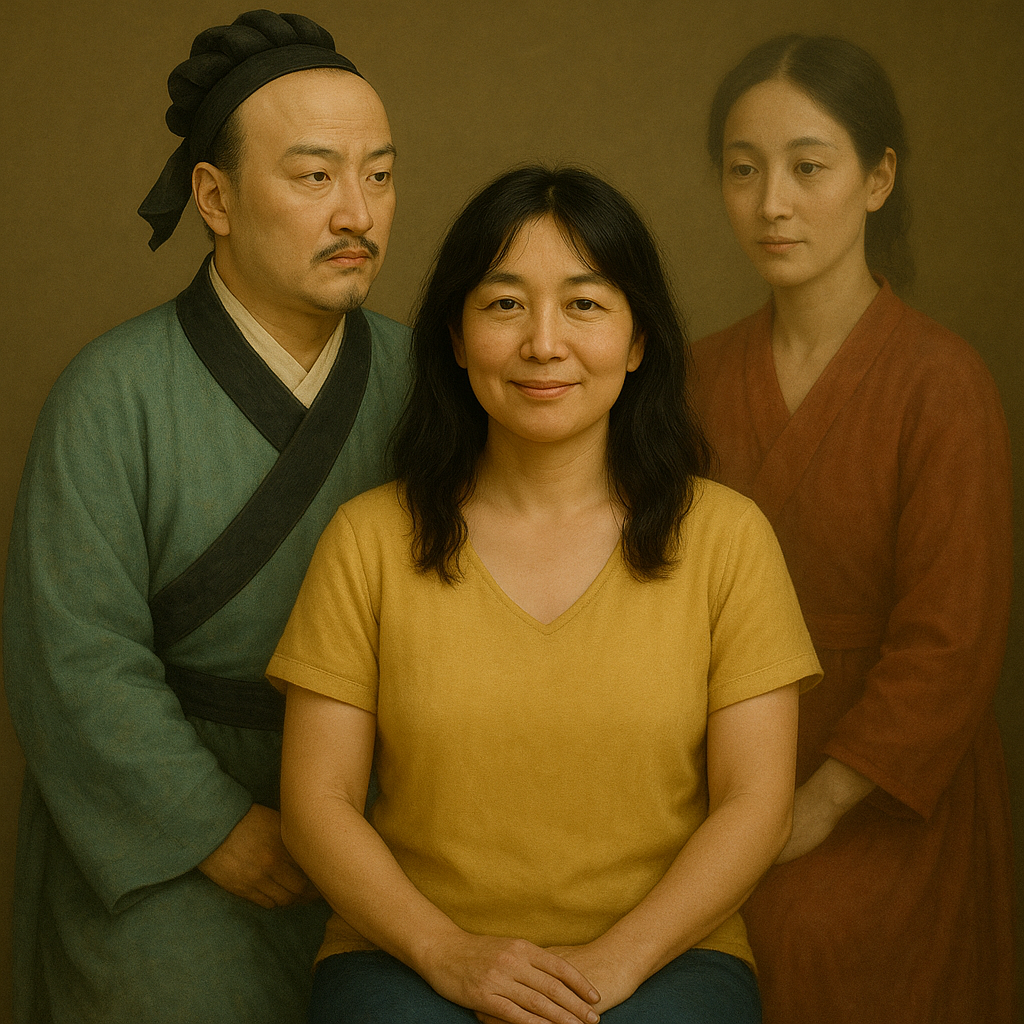
The first in a series of portraits honoring the women who were left out. Created in collaboration with AI.
In the center: Me. A daughter of the 76th generation.
To my right: Zengzi, my most famous ancestor. One of the Four Sages of Confucianism, born in what is now Shandong, China, more than 2,000 years ago.
To my left: His mother. The woman who gave birth to a sage, but whose name was not recorded.
She appears here partially translucent because the world she lived in failed to see her clearly.
This project begins with her.
And with all the wives, concubines, mothers, daughters, and sisters that are unnamed.
The women who carried the line forward, without recognition.
This is the beginning of a series: portraits, stories, and remembrance.
A restoration of what was erased.
I’m listening for what they might have carried.
Who in your lineage was never recorded, but carried everything forward?
Note about AI: In this project, I’m using AI as a bridge to reconnect parts of my ancestry that have been lost. It isn’t meant to be a replacement for human-made art. It’s an experiment to visualize what history left out, and to humanize the unseen.